
Winter snowflakes
White glue snowflakes on dark blue card, coloured with blues and purples. A favourite for the Christmas holidays.
Game Tailors
Source: Salt painting for kids: glue, salt and watercolour
The drawing app where the paper is real. No ads, no accounts, no data collected.
Game Tailors · Schieweg 15Y-40, 2627 AN Delft (NL)
KvK 92437702 · VAT NL866044474B01
info@gametailors.com · +31 6 4227 5919
© 2026 Game Tailors
Art technique
Draw with glue, cover it in salt and touch it with a brush full of watercolour: the colour runs along the salt line by itself. Salt grains soak up water, and the colour travels with the water from grain to grain.
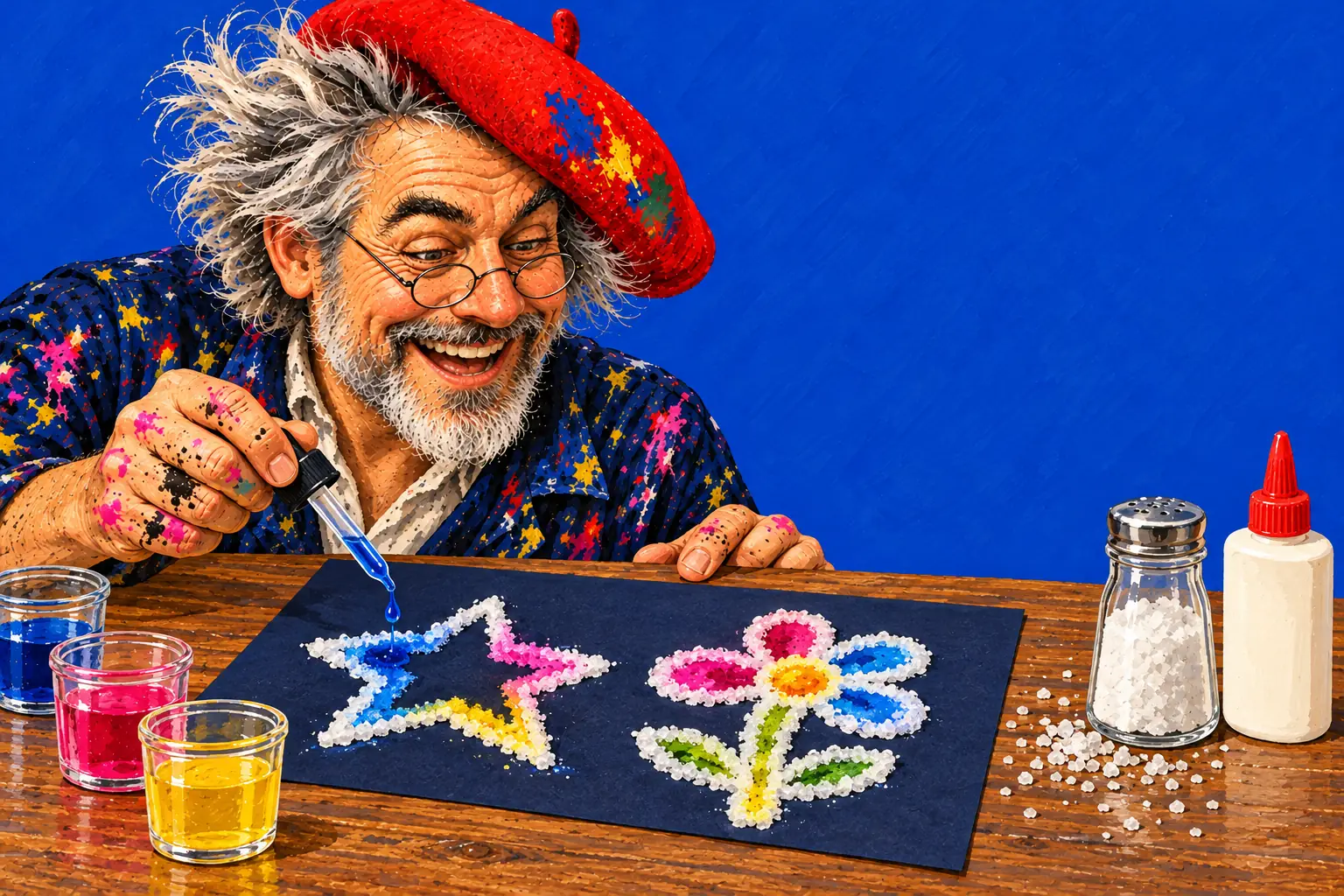
Everything for salt painting is in the free part of the app.
Craft tab → Glue & glitter → Glue. Drag to squeeze a raised, glossy bead of white glue. Draw a star, a snowflake or your name.
Kitchen tab → Sieve → Salt. Shake it over the glue while it is still wet (glue sets in about a minute). The salt sticks to the glue as a sparkly white line; the rest lies loose on the paper.
Add colour. Touch the line with the Watercolour brush, Ink drops (Craft) or Food colouring (Science). The colour soaks into the salt and creeps along the line. Where two colours meet, they blend.
Also try: salt from the sieve on wet watercolour, with no glue at all. Each grain pulls the wet paint in around it and leaves a pale starburst with a darker rim.
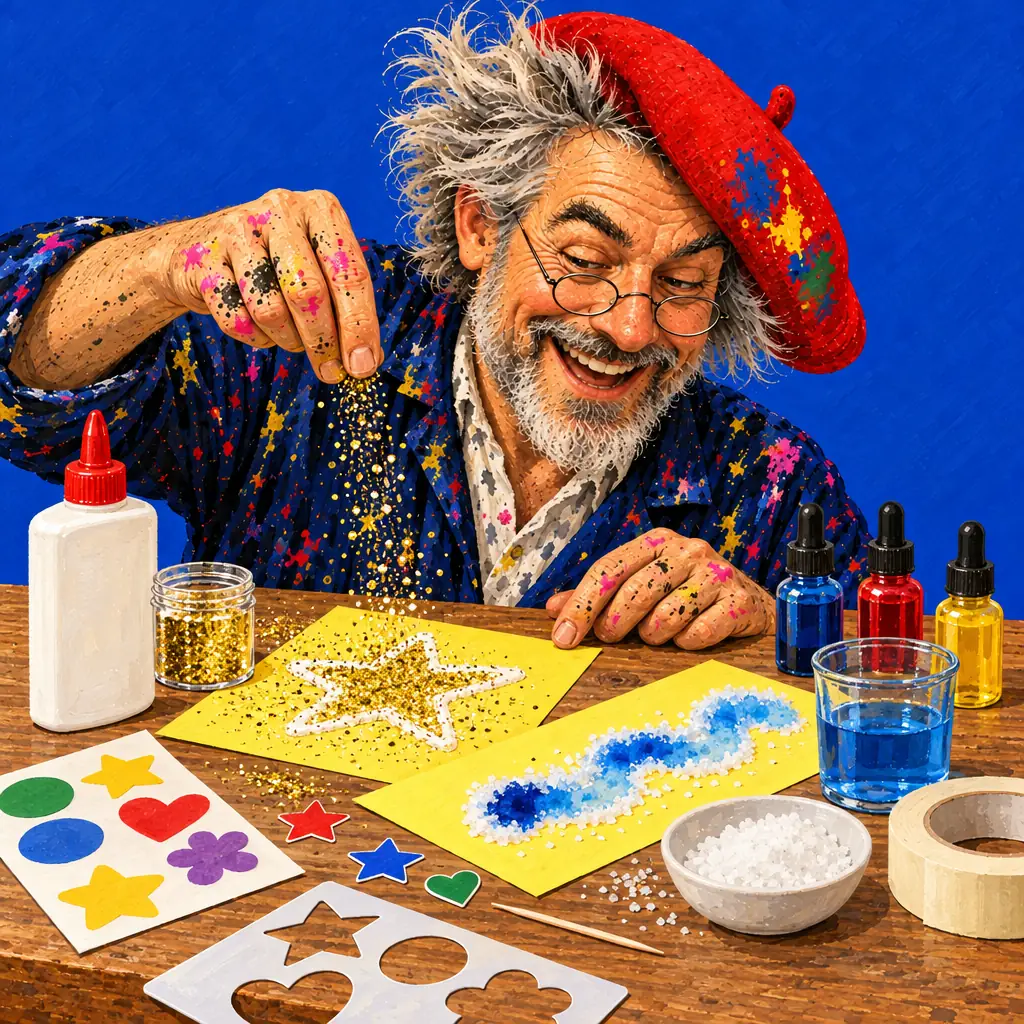
White glue snowflakes on dark blue card, coloured with blues and purples. A favourite for the Christmas holidays.
Lines bursting out from a centre point, with a different colour on each line. Lovely for New Year or a birthday card.
Leaf outlines and veins in glue, then red, orange and yellow dropped in at the stem.
Big bubble letters in glue, one colour per letter. Watch the colours meet where the letters touch.
The colour runs along the salt in seconds, and the salt only sticks while the glue is wet, just as it does for real. You can draw a whole page of glue and fix mistakes with Undo. No salt on the floor, and nothing to wait for overnight.
Slower and less predictable: the colour runs a little way, then stops once the salt near the brush is full, so you add more. Thick lines take a day to dry. The finished picture is bumpy, crunchy and sparkly in a way a screen can’t show.
Salt is thirsty. Each grain pulls in water, and the colour rides along with the water from one grain to the next, until the salt is full.
For grown-ups. Packed salt crystals leave tiny gaps between them, and water moves through those gaps by capillary action (wicking), the same way water climbs a paper towel. Salt is also hygroscopic: it attracts water. The dye or pigment is carried along with the water until the salt near the brush is saturated. On wet watercolour, a grain draws the wet paint towards itself, which leaves a pale, star-shaped patch round it.
For teachers
Salt painting fits KS1 science on everyday materials (which materials soak up water) and NGSS 2-PS1-2 (testing which materials suit a purpose), as well as art lessons on mixed media. Show it on the whiteboard first, then let groups predict which salt carries colour furthest before they try it.
Yes: sprinkle salt straight onto wet watercolour and each grain leaves a pale starburst as it dries. Without glue the salt doesn’t stay in lines, so you get a texture rather than a drawing that the colour runs along.
Runny colour: watercolour mixed very wet, liquid watercolour, or food colouring with a little water. Thick poster paint sits on top of the salt and doesn’t travel.
Usually overnight, and up to a day for thick glue lines. Keep it flat while it dries.
The glue had started to dry before the salt went on, or the picture was bent or tipped while wet. Work in small sections and add the salt straight away.
Yes. Glue & glitter, the salt sieve, watercolour, ink drops and food colouring are all in the free part of the app.

Wet-on-wet, blooms and salt starbursts, and what the paper does as it dries.

Paint over a white crayon drawing and watch it appear.

Salt-painted snowflakes, a frozen snowman and more for the winter holidays.