
Fridge, counter or warm spot?
Make three small balls of dough. Which rises fastest: in the fridge, on the counter, or near a warm (not hot) radiator?
Game Tailors
Source: Bread and yeast experiment for kids: why dough rises
The drawing app where the paper is real. No ads, no accounts, no data collected.
Game Tailors · Schieweg 15Y-40, 2627 AN Delft (NL)
KvK 92437702 · VAT NL866044474B01
info@gametailors.com · +31 6 4227 5919
© 2026 Game Tailors
Kitchen science experiment
Yeast is a living fungus. Kept warm in dough, it feeds on sugars and gives off carbon dioxide, and the stretchy gluten you build by kneading traps the bubbles, so the dough rises. The oven sets the bubbles and browns the crust.
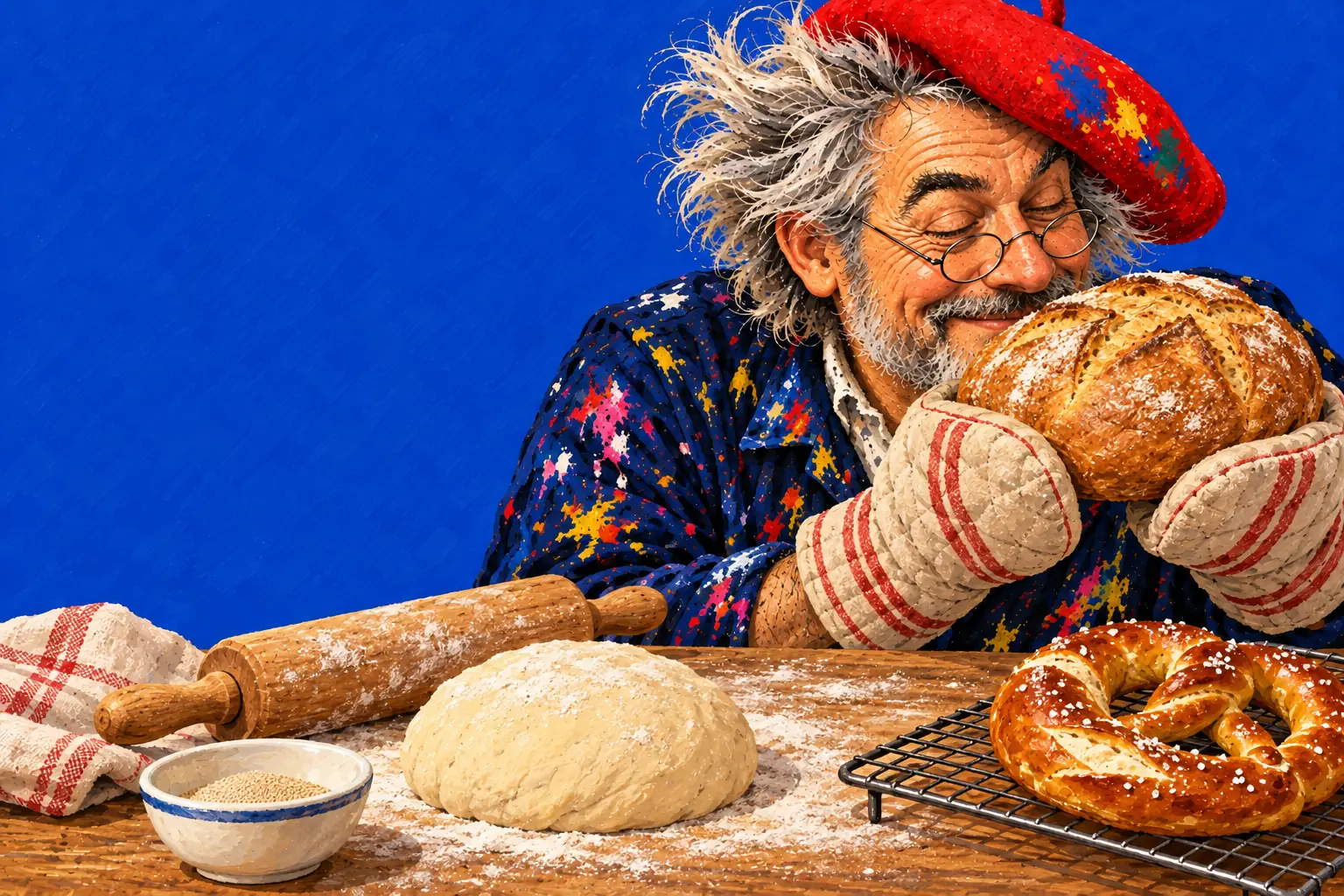
Make the dough. Pour a puddle of water (Bathroom tab), then shake Flour from the sieve on the Kitchen tab into it. The flour drinks the water and turns into shaggy dough, lumpy and dusty. Drag the hand over it again and again to knead it: it goes smooth and stretchy. Shake in a little Yeast and Salt and they get worked in and travel with the dough.
Roll and fold. The Rolling pin rolls kneaded dough into a sheet, and a dusting of flour stops it sticking. Take the sheet by its edge with the hand and drag across to fold it over. Lay a slice of Butter on it, fold and roll a few times, and you get flaky croissant layers.
Let it rise. Tap Wait 1 hour on the Time tab and yeasted dough proves: it rises and spreads. Yeast works fastest near 35 °C, slowly when cool, and stops above 55 °C; salt slows it and a little sugar feeds it. Leave it far too long and the game tells you the dough rose too long and sank.
Bake it. Bake in the oven gives twenty minutes at 180 °C. Proved dough comes out risen and full of holes with a golden-brown crust; dough that wasn't kneaded bakes dense.
Two more to try:
Soda bread. No yeast: sift baking soda (Science tab) onto the dough, drip on some vinegar and knead it in. The fizz happens inside the dough, so instead of foaming over, the dough rises.
Pretzel brown. Sift baking soda over dough and bake it: the crust goes a deep pretzel brown. Browning depends on pH: soda speeds it up, lemon or vinegar slows it down.

You need (makes one loaf or 8 rolls)
500 g strong white bread flour (plain flour works too, a little flatter)
1 sachet (7 g) fast-action dried yeast
1 level teaspoon salt
1 tablespoon oil or soft butter (optional)
About 300 ml lukewarm water: warm on your wrist, not hot
A big bowl, a baking tray, a clean tea towel
Oven gloves for the grown-up
Put the flour in the bowl. Add the salt on one side and the yeast on the other: salt touching the yeast slows it down.
Pour in the oil and most of the water. Stir with a spoon, then with your hands, into a rough, shaggy dough. Add the rest of the water if it is dry.
On a lightly floured table: push the dough away with the heel of your hand, fold it back, turn it, repeat. It goes from lumpy and sticky to smooth and stretchy. Take turns!
Put it back in the bowl, cover with the tea towel and leave somewhere warm for about an hour, until it has doubled. Poke it: the dent should fill back slowly.
Press the air out, then shape a loaf or 8 rolls on the floured tray. Cover and leave for another 20 to 30 minutes to puff up again.
Heat the oven to 220 °C (200 °C fan, gas 7). Bake rolls for 15 to 20 minutes or a loaf for 25 to 30, until golden and hollow-sounding when tapped underneath. Cool on a rack.
For kids: yeast are tiny living things, far too small to see one by one. In warm dough they eat sugar from the flour and breathe out gas. Kneading makes the dough stretchy, like a balloon skin, so the bubbles stay inside and the dough puffs up. In the oven the bubbles set, and the outside turns golden and crunchy.
For grown-ups: baker's yeast (Saccharomyces cerevisiae) ferments sugars, many released from starch by the flour's own enzymes, into carbon dioxide and a little alcohol. It is fastest at around 30 to 35 °C, slow in the cold and killed at around 55 to 60 °C; salt slows it by drawing water out of the cells. Kneading lines up the wheat proteins into a gluten network that holds the gas. In the oven the gas expands (oven spring), then the starch gelatinises and the proteins set: an irreversible change. The crust browns by the Maillard reaction, which runs faster in alkaline conditions. That is why pretzels dipped in an alkaline bath bake mahogany brown, and why a lemony dough browns less. Soda bread rises by the same acid and base fizz as a baking soda volcano, trapped inside the dough.
In the game warmth, gluten, salt, sugar and acidity are separate properties of the dough and the paper, so they combine on their own: warm, kneaded, salted dough behaves differently from cold, shaggy, sugared dough without anyone writing a rule for each.
Bread and yeast fits KS2 Year 6 "living things and their habitats" (micro-organisms, with yeast as a helpful one) and Year 5 irreversible changes, and NGSS 2-PS1-4 (heating causes changes, some of which can't be reversed). Proving and baking on the whiteboard takes seconds, so the whole class can compare kneaded and unkneaded dough before lunch.
Yeast in the dough feeds on sugars and gives off carbon dioxide gas. The stretchy gluten from kneading traps the bubbles, so the dough swells.
Lukewarm, around 30 to 35 °C. It works slowly in the cold and dies above about 55 to 60 °C, which is why the water should feel warm, not hot.
Kneading builds gluten, a stretchy network of wheat proteins. Without it the gas escapes and the bread bakes dense and flat.
Yes: soda bread. Bicarbonate of soda reacts with the acid in buttermilk or yoghurt and the gas raises the dough, with no rising time needed.
They are dipped in an alkaline solution before baking. The browning reaction runs much faster when the surface is alkaline.

What grows on bread you leave out, and what keeps it away.

The fizz that also raises soda bread.

Freezer against oven: which changes can you undo?