
No soap?
Leave the soap out. You'll see fizzing but hardly any foam. Where did the oxygen go?
Game Tailors
Source: Elephant toothpaste experiment for kids, done safely
The drawing app where the paper is real. No ads, no accounts, no data collected.
Game Tailors · Schieweg 15Y-40, 2627 AN Delft (NL)
KvK 92437702 · VAT NL866044474B01
info@gametailors.com · +31 6 4227 5919
© 2026 Game Tailors
Kitchen science experiment
Elephant toothpaste is a bottle that pours out a fat column of foam. Yeast makes hydrogen peroxide break down into water and oxygen very fast, dish soap traps the oxygen in bubbles, and the reaction gives off heat, so the foam is warm.
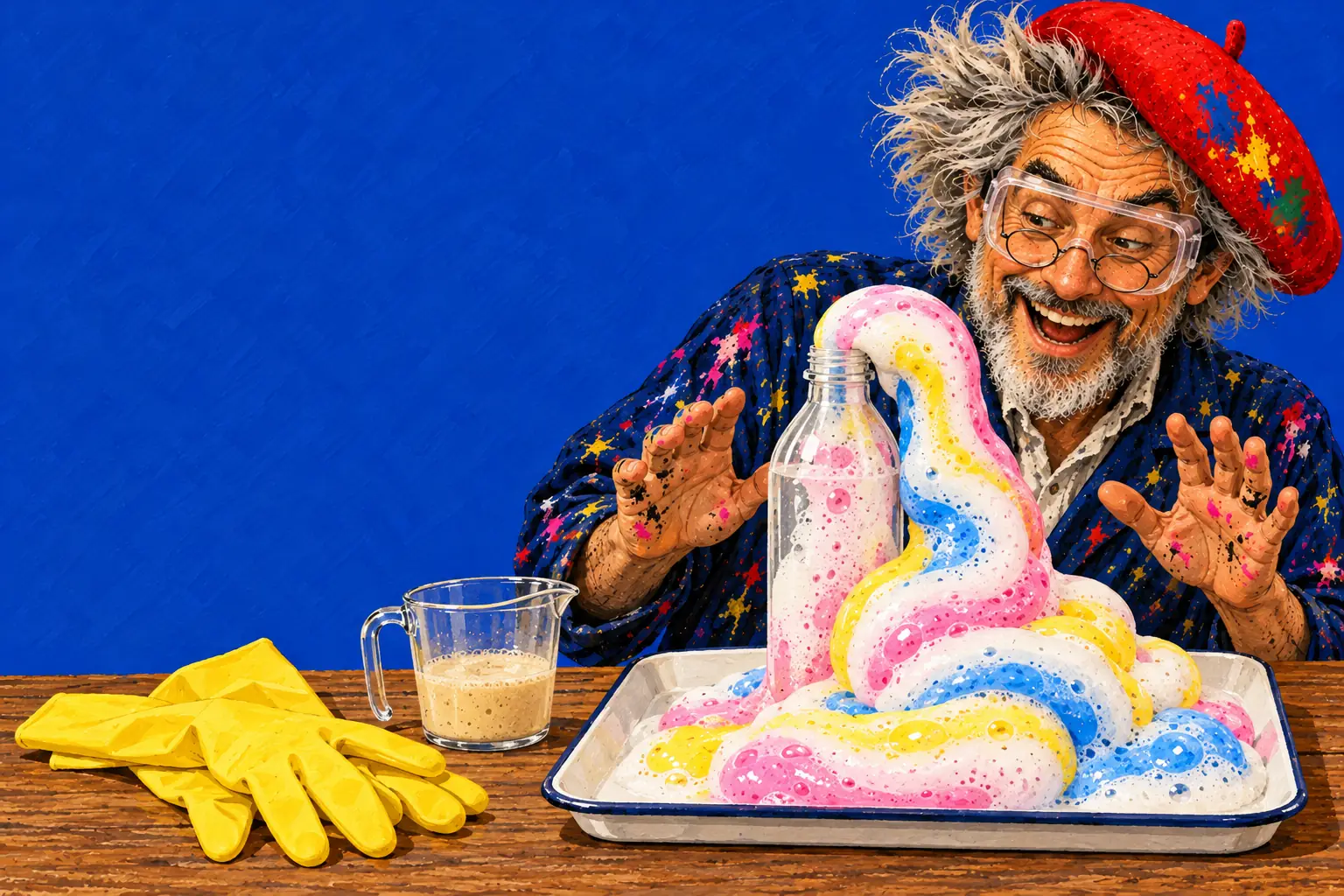
Open the Science tab (free), tap Eruptions and choose Elephant toothpaste. Then tap the paper where the bottle should stand.
For about four and a half seconds a fat, stripy snake of foam (pink, yellow, blue and white) pushes out of the bottle mouth. It wobbles off in a random direction and piles up with bubbles. The spot under the bottle gets warm, just as a real bottle does.
The foam behaves like foam: it runs and spreads, then slowly collapses and leaves its stripes behind as stains in the paper. Tilt the page (or paint at the easel) and it slides downhill. Pat it with the hand, the hammer or the iron and the bubbles pop.
No goggles, no peroxide, no clean-up: set off as many bottles as you like, then do it once for real.
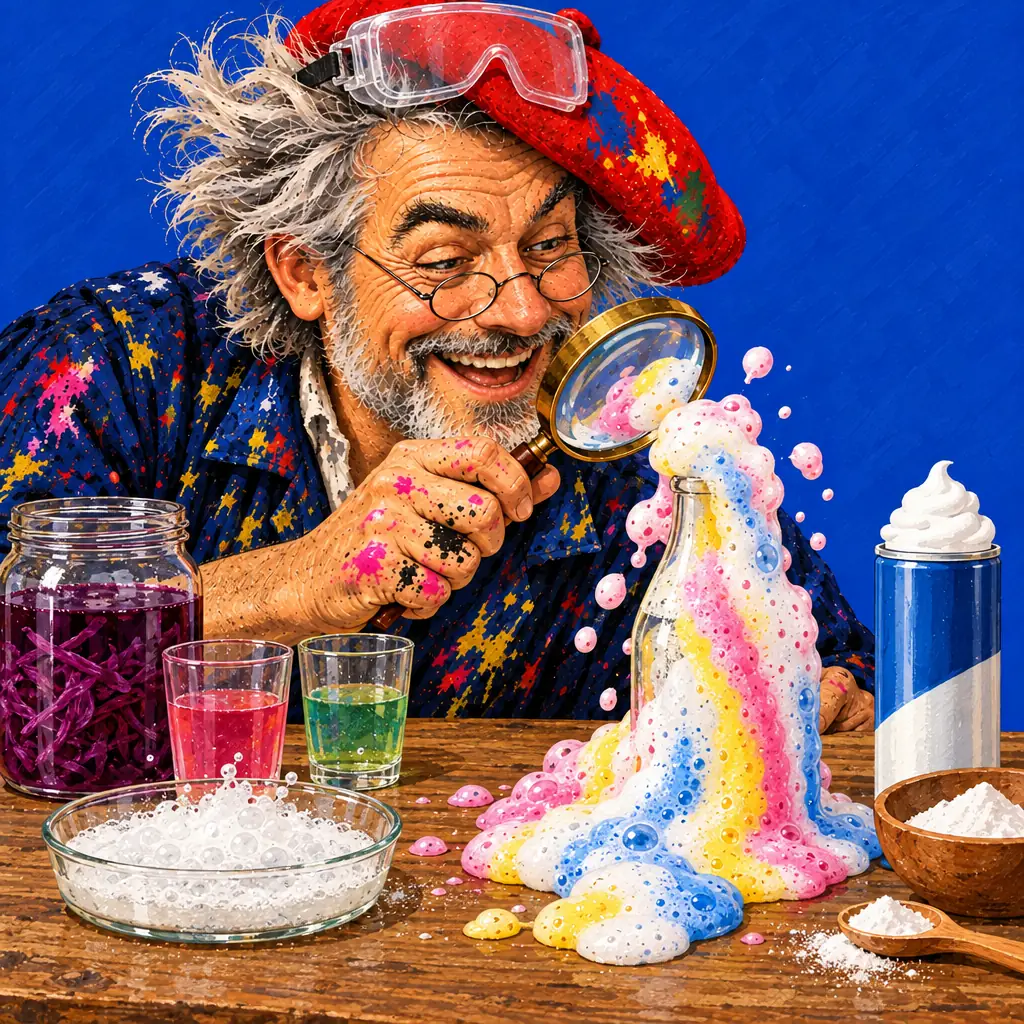
You need
120 ml (half a cup) of 3% hydrogen peroxide, the household strength sold in pharmacies and supermarkets. Never anything stronger.
1 tablespoon (one sachet) of dry yeast
3 tablespoons of warm water
1 tablespoon of dish soap (washing-up liquid)
A few drops of food colouring (optional)
A clean 500 ml plastic bottle and a funnel
A tray or a deep baking dish to catch the foam
Safety goggles for everyone close by, and gloves for the adult
The grown-up pours the peroxide. The children mix the yeast, add the colour and do the predicting.
Stand the bottle in the tray, outside or on a wipeable kitchen surface. Goggles on for everyone.
With the funnel, the adult pours the hydrogen peroxide into the bottle, then the dish soap. A child can add a few drops of food colouring and the adult swirls it gently.
In a small cup, the child stirs the yeast into the warm water for about 30 seconds until it's a smooth, runny paste. This is the safe job for small hands.
How tall will the foam get? Will it be hot or cold? Draw a line on a piece of card to mark your guess.
The adult pours the yeast paste into the bottle through the funnel, pulls the funnel away and everyone takes a step back.
The foam pushes out for a minute or so. When it has stopped, the adult can let children hold a hand near the bottle to feel that it's warm.
The adult rinses the foam and what's left in the bottle down the sink with plenty of water. Everyone washes their hands.
The peroxide is full of oxygen that wants to get out. The yeast helps it escape all at once, and the soap catches it in bubbles, so out comes a giant warm snake of foam.
For grown-ups. Hydrogen peroxide (H₂O₂) slowly breaks down into water and oxygen on its own: 2 H₂O₂ → 2 H₂O + O₂. Yeast contains an enzyme, catalase, that speeds this up enormously. It's a catalyst: it makes the reaction go faster without being used up. The dish soap catches the sudden rush of oxygen in millions of bubbles, so the gas comes out as foam instead of escaping into the air. Breaking down peroxide releases energy as heat, so it's an exothermic reaction, and you can feel it in the bottle. With 3% peroxide the foam is warm, not hot. The oxygen gas is a new substance that wasn't in the bottle before, and the change can't be undone: that's how you know it's a chemical change.
For teachers
A new gas, heat and no going back: it fits KS2 Year 5 properties and changes of materials (irreversible changes that make new materials) and NGSS 5-PS1-4 (mixing substances can make a new substance). For older pupils it introduces catalysts and exothermic reactions (KS3 chemistry, NGSS MS-PS1-2). Show the app version on the whiteboard first, so the whole class sees it up close, then do one bottle as a teacher demonstration with goggles.
The home version is safe when an adult handles the 3% hydrogen peroxide, everyone wears goggles and nobody touches the foam until the adult says so. Children can safely mix the yeast and add the colour. Never use stronger peroxide.
Not the real reaction: the peroxide is where the oxygen comes from. For a peroxide-free foam, add dish soap to baking soda and vinegar. It foams up too, with carbon dioxide instead of oxygen, and it doesn't get warm.
Breaking hydrogen peroxide down into water and oxygen releases energy as heat. That makes it an exothermic reaction. With household 3% peroxide the foam and bottle feel warm, not hot.
Because the thick foam squeezing out of the bottle looks like toothpaste coming out of a tube big enough for an elephant.
Let the adult rinse it down the sink with plenty of water. It's mostly water, soap, yeast and oxygen bubbles, but there can be a little peroxide left in it, so it isn't for playing with or tasting.
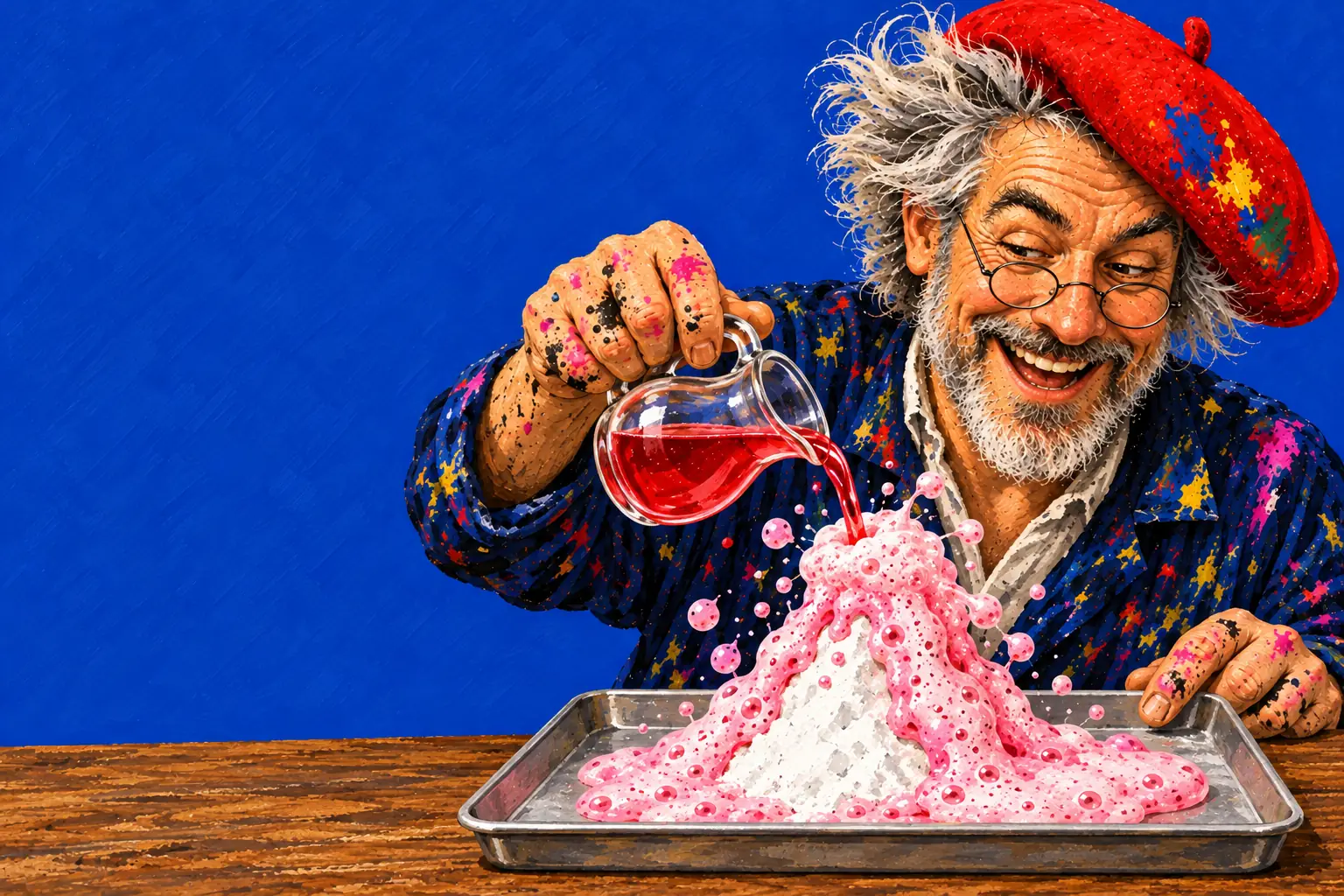
The classic volcano: coloured foam that fizzes up wherever an acid meets the powder.
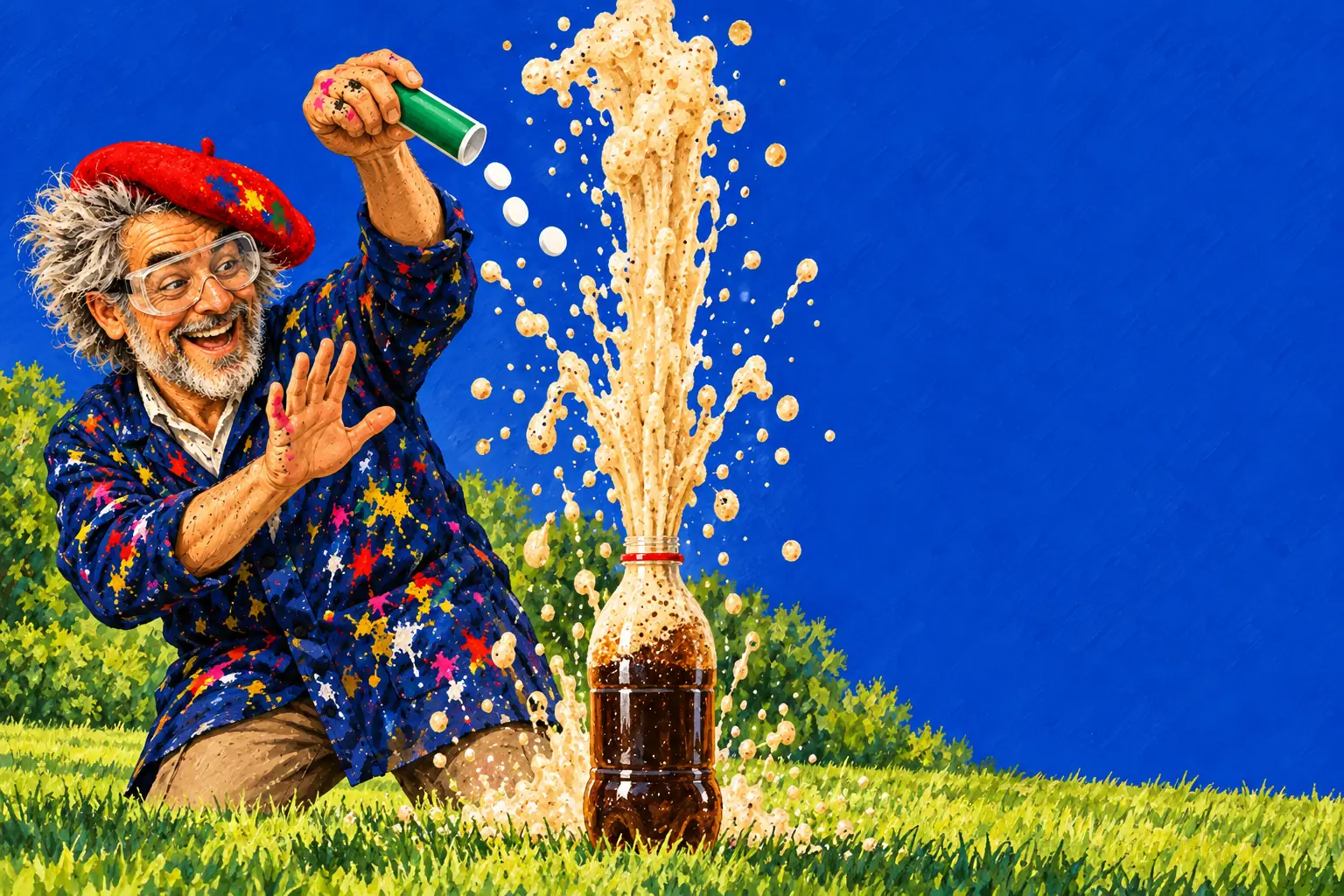
A fountain of cola that isn't a chemical reaction at all.

What stays on the screen only, and why: bleach and vinegar, fire, the grease fire.